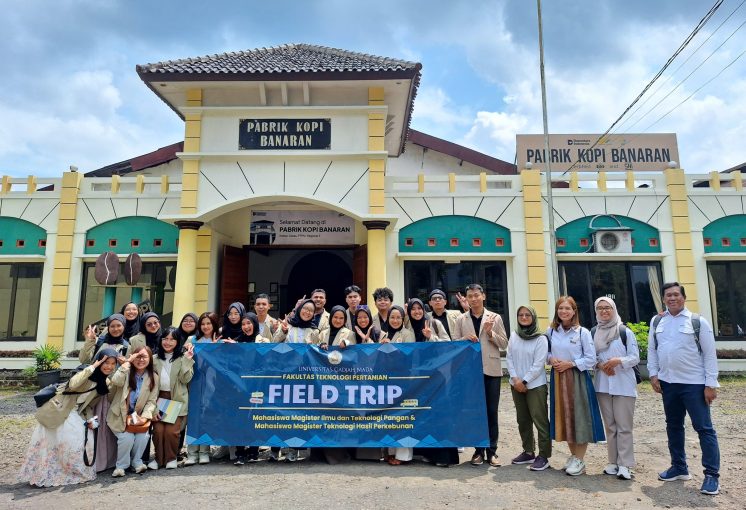
The Master’s Program in Food Science and Technology (MFST), Faculty of Agricultural Technology, Universitas Gadjah Mada, organized an industrial visit for the even-semester 2025 student cohort to Banaran Coffee Factory and Museum in Semarang and Pawon Luwak Coffee in Magelang on Monday, 27 April 2026. The students were accompanied throughout the visit by Dr. Widiastuti Setyaningsih, S.T.P., M.Sc., and Dr. Qurrotul A’yun, S.T.P., M.Sc.
The visit provided students with a contextual learning experience to observe coffee processing practices directly. Through this activity, students were encouraged to connect classroom learning with real industry conditions, including raw material handling, production processes, quality control, and sustainability challenges in business operations.
 The first visit took place at Banaran Coffee Factory and Museum. During the visit, students were introduced to coffee from various perspectives, including its history, the characteristics of different coffee types, and various coffee-based beverage products. They also had the opportunity to observe the storage area, learn about dry and wet coffee processing methods, and understand the functions of several production tools. One of the tools introduced was the raung pulper machine, which is used to separate the skin of coffee cherries while also supporting the washing process.
Although the factory was not operating during the visit, students still received detailed explanations of the production stages and the role of each tool in coffee processing. They also learned about the types of coffee plants cultivated at the site and the differences between roasting levels, from light roast to dark roast, which affect the aroma, flavor, and quality of brewed coffee.
The activity then continued to Pawon Luwak Coffee in Magelang. There, students gained a closer look at the production of civet coffee, including an introduction to civets and the post-harvest stages of civet coffee processing. Students also tried using conventional tools to remove the parchment layer of coffee beans and tasted Arabica and Robusta civet coffee to identify the differences in flavor characteristics between the two types.


As part of case based learning, students were then asked to analyze the results of the visits to both locations. Their analysis included identifying problems, exploring opportunities for innovation and research, and preparing recommendations for improvement according to the characteristics of each industry. Through this approach, the activity not only provided field observation experience, but also helped students develop critical, practical, and solution-oriented thinking in responding to real issues in the food industry.
This industrial visit reflects MFST UGM’s commitment to providing learning experiences that are relevant to industry needs. Through direct field exposure, students are expected to strengthen their understanding of coffee processing while developing analytical and innovative skills to support the advancement of Indonesian food and plantation commodities.