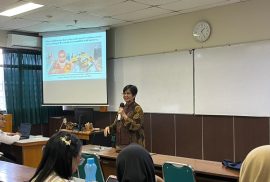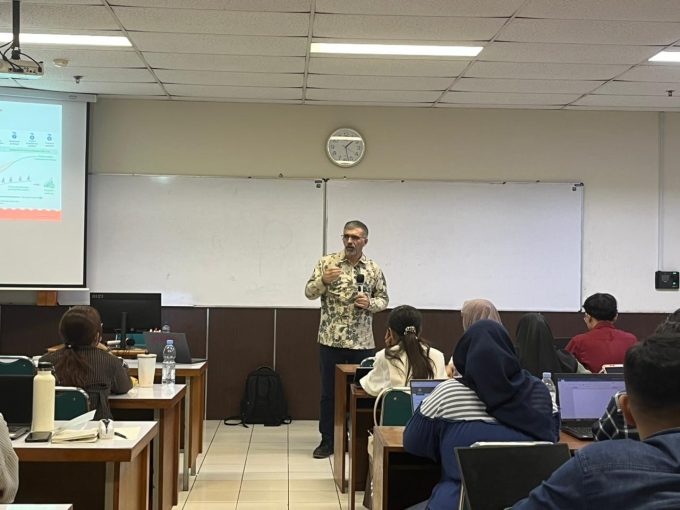
Students of the Master’s Program in Food Science and Technology (MFST), Department of Food and Agricultural Product Technology, Faculty of Agricultural Technology UGM, joined a guest lecture with Prof. Mohammad Taherzadeh, Chief Scientific Officer at Millow AB, Sweden, on Tuesday, May 12, 2026. The session offered students valuable insights into academic careers, research development, and entrepreneurship in the field of food biotechnology.
During the lecture, Prof. Taherzadeh shared his career journey, from his early experience as a student researcher to becoming a professor and entrepreneur. He explained that his interest in biotechnology began with his understanding of microorganisms as catalysts in various chemical reactions. His academic journey at Lund and Chalmers also shaped his view that a career in academia requires more than research skills. It also calls for practical abilities, including patent negotiation, team management, budgeting, and the ability to communicate and present ideas to industry partners and investors.
A key message highlighted in the lecture was the importance of understanding research downstreaming and the concept of Technology Readiness Level. Prof. Taherzadeh explained that many research findings fail to develop into market-ready products because they struggle to pass through the “Valley of Death,” a critical stage where academic discoveries must be transformed into innovations that can be applied in industry. He encouraged students to think carefully about the purpose of their research from the beginning, whether it is intended to produce scientific publications, build research networks, or develop products with economic value and real-world impact.
Drawing on his experience as both an academic and the founder of Millow AB, Prof. Taherzadeh also emphasized the importance of communication skills for researchers. When engaging with industry partners, researchers need to explain their solutions in a simple, relevant, and business-oriented way. He noted that industry is not only interested in theoretical depth, but also in the practical impact, feasibility, and added value that an innovation can offer.
Through this guest lecture, MFST students gained a broader perspective on the importance of developing research that is not only academically strong, but also relevant to industry needs and global challenges. The session also aligned with UGM’s commitment to supporting the Sustainable Development Goals (SDGs), particularly SDG 9 on industry, innovation, and infrastructure, as well as SDG 4 on quality education. It is expected that the lecture will encourage students to develop food and biotechnology innovations that are applicable, competitive, and beneficial to society.