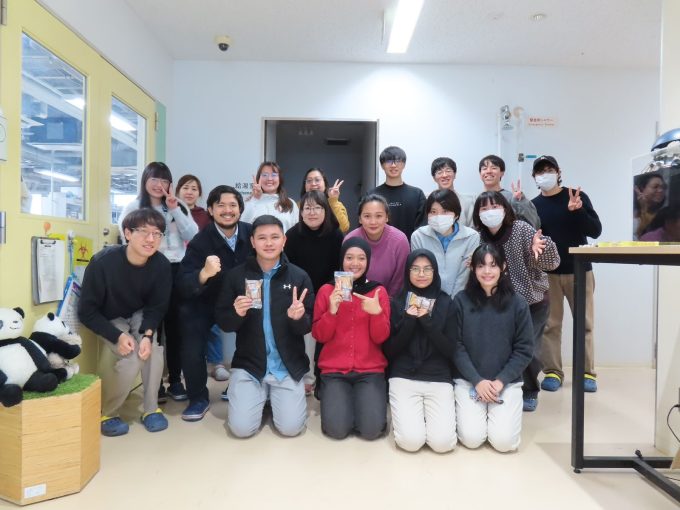
Two students from the Master’s in Food Science and Technology, Faculty of Agricultural Technology, Universitas Gadjah Mada (UGM), Az-zahramidha Pradichaputri and Muzdalifah, have successfully completed their academic activities at Osaka University, Japan, through the Osaka University International Certificate Program (OUICP). This international program took place from 1 December 2024 to 31 August 2025, combining an online learning phase with a Program Study Abroad (PSA) conducted from 28 February to 2 May 2025. They joined the program alongside fellow participants from Malaysia, Brunei Darussalam, and Thailand.

OUICP is a flagship program designed by Osaka University to promote internationalization in higher education and provide students with structured exposure to advanced scientific research. The program offers several thematic tracks that allow participants to explore cutting-edge topics guided by experienced Japanese researchers. Through this initiative, students gain hands-on experience in laboratory settings, expand their global network, and enhance their academic and professional competencies.
Az-zahramidha participated in the Industrial Biotechnology track and conducted her research at the International Center for Biotechnology (ICBiotech). Under the supervision of Professor Fujiyama Kazuhito, Director of ICBiotech, she worked on research projects involving exopolysaccharides (EPS) and biodiesel production. This opportunity allowed her to become familiar with advanced biotechnological methods and to engage in collaborative work within an international research team.
Meanwhile, Muzdalifah joined the Halal Science, Technology, and Innovation (HaSTI) track, focusing on Untargeted Lipidomics for Halal Authentication. Her research was carried out at the Experimental Institute for Medicinal Plants under the supervision of Kazuo Harada, Ph.D. Throughout the program, she gained practical laboratory skills and deepened her knowledge in analytical chemistry and lipid profiling techniques, which are crucial for scientific advancements in halal product authentication and safety.
 The OUICP program fostered academic growth, enhanced cross-border scientific collaboration, and strengthened students’ competencies in global research environments. This participation also supports the Sustainable Development Goals (SDGs), particularly SDG 3 (Good Health and Well-being), SDG 7 (Affordable and Clean Energy), and SDG 12 (Responsible Consumption and Production).
Through OUICP, the collaboration between UGM and Osaka University continues to deepen, promoting the development of globally competitive human resources and advancing knowledge exchange in biotechnology and related disciplines.